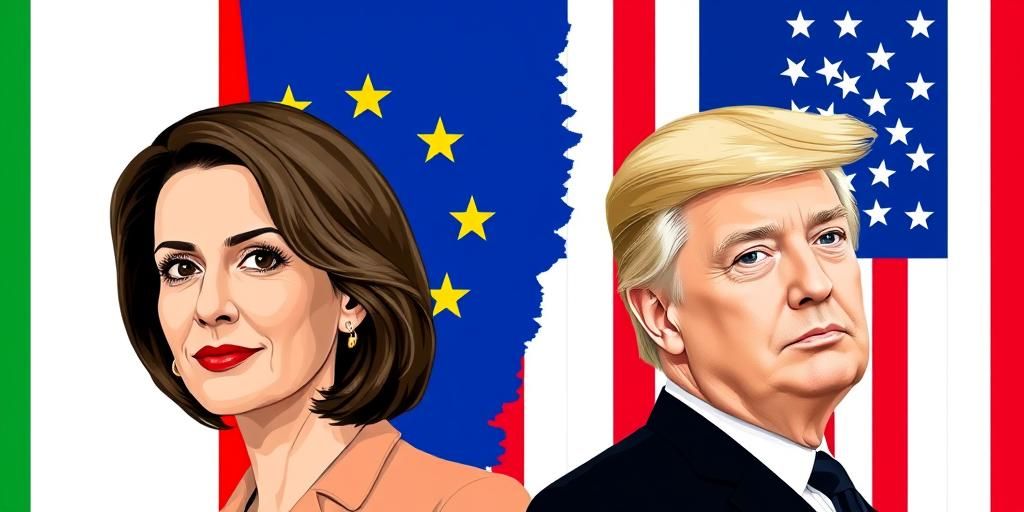
Italian Prime Minister Giorgia Meloni has voiced strong concerns over the escalating trade tensions within Western allies following the United States’ recent decision to impose hefty tariffs. In response to President Donald Trump’s announcement of 30% tariffs on imports from the European Union and Mexico, effective August 1, Meloni cautioned that such internal trade conflicts would ultimately weaken the Western bloc amid global economic challenges.
Trade Tensions Rise Between US and EU
Speaking shortly after the tariff announcement, Meloni emphasized Europe’s capacity to negotiate fairly and sensibly. “Europe possesses the economic and financial strength to assert its position and reach a fair and sensible agreement,” she stated. The Italian leader reaffirmed Italy’s commitment to play its part in addressing the dispute constructively as the European Union carefully considers its next steps.
President Trump’s tariff plan targets a wide range of products from the EU and Mexico, marking a significant escalation in already strained transatlantic trade relations. Brussels, led by European Commission President Ursula von der Leyen, has so far refrained from retaliating against existing US tariffs on steel and aluminum, signaling a preference for negotiation over immediate retaliation. This cautious approach aims to avoid broader tariffs—potentially extending a 30% levy to a much wider array of EU exports.
Within Italy, the announcement has sparked political debate. Opposition parties have criticized Meloni and her right-wing Brothers of Italy party for their handling of the situation. Giuseppe Conte, leader of the opposition Five Star Movement and former Italian Prime Minister, accused Meloni of yielding too readily to Washington’s pressure.
This latest episode adds to the complex fabric of international trade and diplomacy, highlighting the fragility of cooperation among longstanding allies. With global challenges such as China’s rising economic influence and shifting alliances, the unity of Western economies remains crucial—but currently vulnerable.
As governments and trade bodies navigate these unsettled waters, all eyes will be on how Europe balances defense of its economic interests with the desire to maintain cohesion within the transatlantic alliance. The coming weeks could set important precedents for global trade dynamics in a rapidly changing geopolitical environment.
What remains clear is that a trade war between Western powers would carry risks far beyond mere tariffs, potentially undermining collective strength on the world stage and complicating responses to shared challenges.
Leave a Reply