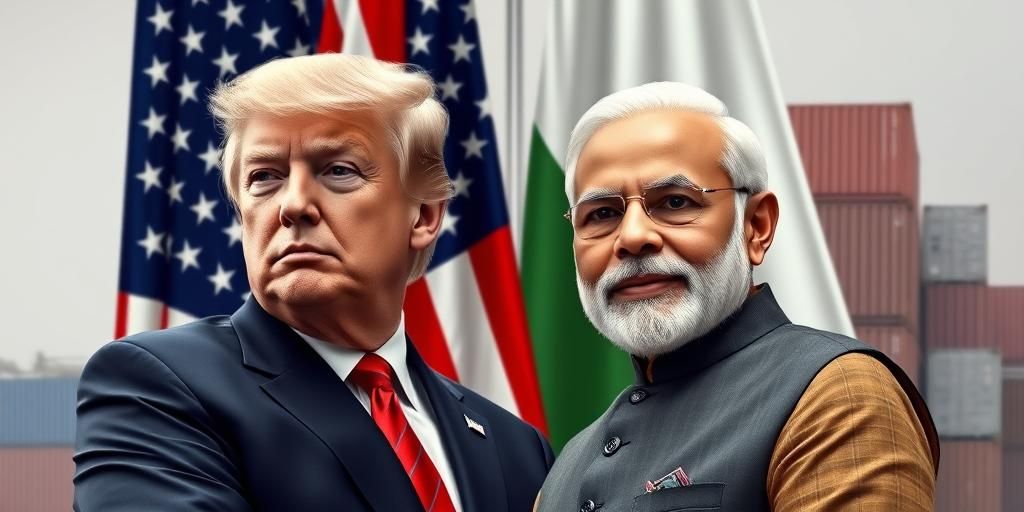
US President Donald Trump recently indicated that a new trade agreement with India is on the horizon, signaling progress in ongoing negotiations as a crucial tariff deadline approaches. Speaking during a bilateral meeting with Bahrain’s Crown Prince Salman bin Hamad bin Isa Al Khalifa, Trump highlighted August 1 as an important date, when significant tariff revenues are expected to flow into the United States.
“We’ve already brought in over $100 billion,” Trump noted, emphasizing that many tariffs have yet to fully take effect, except those on automobiles and steel. “August 1st is when a very substantial amount of money will come into our country.” The president mentioned that the US has secured multiple trade deals recently and suggested India could soon be next on the list.
Trump explained the framework of these agreements, stating, “The best deal we can make is to send out a letter that specifies tariff rates—30%, 35%, 25%, 20%. We are very close to a deal with India where they open up their markets.”
Trade Talks Gain Momentum in Bilateral Relations
In recent weeks, the United States has been negotiating a bilateral trade agreement with India aimed at easing market access and reducing trade barriers. Indian government officials confirmed that their negotiation teams are currently in the US conducting the fifth round of talks, in line with directives from Prime Minister Narendra Modi and President Trump. The process remains aligned with previously agreed terms of reference.
Trump also announced progress on a separate trade deal with Indonesia, noting that the country will see its tariff rate lowered to 19%. These developments highlight Washington’s broader strategy of leveraging tariffs to gain improved market access in key emerging economies.
For decades, US-India trade has faced challenges, including barriers in market entry, regulatory hurdles, and tariff disputes. The potential agreement reflects ongoing efforts to strengthen economic ties between the two democracies, which have grown significantly in recent years amid closer strategic cooperation.
While the details of the proposed US-India trade deal remain under wraps, the president’s remarks suggest an emphasis on reciprocal market openness and tariff adjustments. August 1 is viewed as a pivotal moment when current tariff measures could yield substantial revenue, underscoring the high stakes of these negotiations.
As global trade dynamics continue to evolve amid shifting geopolitical and economic landscapes, the forthcoming US-India agreement may play a key role in shaping bilateral commerce and regional economic partnerships.
What effect this emerging trade pact will have on the broader global trading system and on India-US relations remains to be seen.
Leave a Reply