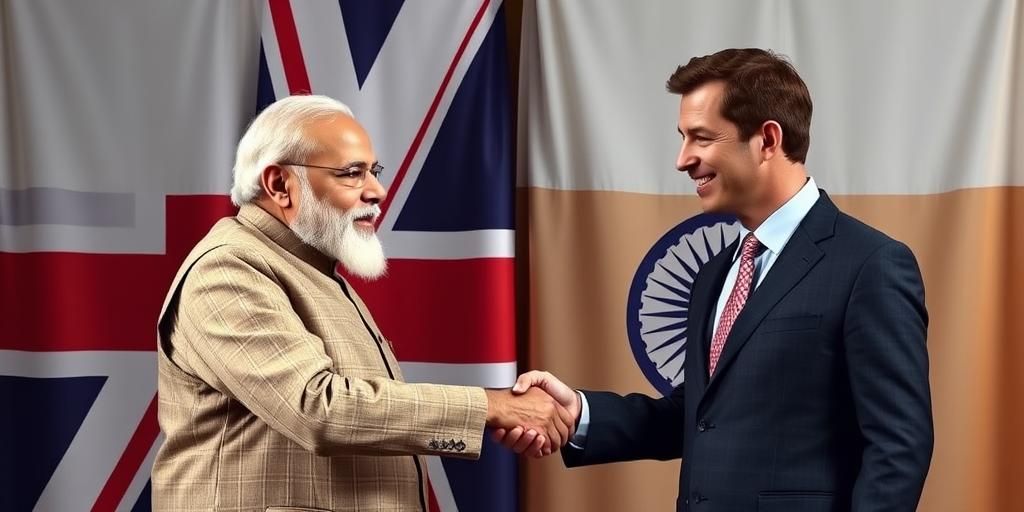
Indian Prime Minister Narendra Modi is currently on a state visit to the United Kingdom to finalize a significant free trade agreement between the two nations. This milestone deal marks the most important economic partnership for the UK since Brexit and represents India’s first major free trade agreement outside Asia. Observers see this pact as a vital step toward strengthening long-term economic ties amid shifting global trade dynamics shaped by protectionist policies in other major economies.
Trade Deal Details and Strategic Gains
During his two-day visit, Modi is engaging in comprehensive discussions with UK Prime Minister Keir Starmer covering trade, defence, technology cooperation, and security. Modi will also meet King Charles as part of the official visit. Negotiated by Modi’s commerce minister Piyush Goyal, the agreement reflects India’s firm stance on several critical demands, including work visa concessions, recognition of professional qualifications, and exemptions on national insurance contributions for Indian workers temporarily in the UK.
The agreement commits to eliminating tariffs on 99% of Indian exports to the UK, encompassing sectors like gems, textiles, engineered goods, leather, garments, and processed foods. In return, the UK will gradually reduce tariffs on 90% of its exports to India. Notable immediate cuts include slashing duties on Scotch whisky from 150% to 75%, eventually reaching 40% over the next decade. British car manufacturers—previously subjected to tariffs over 100%—will see duties lowered to 10% within an agreed quota. Additional benefits are expected for medical devices, pharmaceuticals, aircraft components, and electronics.
Alongside economic advantages, this pact opens access for British businesses to India’s extensive government procurement sector, with promising prospects for industries such as clean energy, infrastructure, and transport. This aspect represents a significant first in India’s trade policy, traditionally cautious about foreign market access.
India’s export-led sectors, particularly labour-intensive industries, stand to gain considerably. According to Amrita Saha, a research fellow at the University of Sussex’s Institute of Development Studies, over five million jobs in India are connected to exports to the UK, highlighting this deal’s potential to invigorate employment and foreign direct investment—a sector vital to India’s “Make in India” initiative but recently experiencing slower growth.
However, agriculture, which employs more than 40% of India’s workforce, remains outside the deal, signaling a red line for New Delhi. This sector was also a sticking point in India’s stalled trade negotiations with the United States. Additionally, financial and legal services were excluded, with ongoing discussions over a bilateral investment treaty that would provide greater investor protection.
The pact also sidesteps the UK’s controversial carbon border adjustment mechanism (CBAM). Designed to tax imports from countries with laxer emissions standards, CBAM has drawn criticism from India and other developing economies for potentially undermining their trade competitiveness. Experts caution that this unresolved issue could diminish the benefits of the free trade agreement for Indian exporters.
Despite pending parliamentary ratification in both countries—likely delaying full implementation until mid-2026—the agreement is widely regarded as a breakthrough in UK-India relations. While the finer details remain to be scrutinized, this trade deal symbolizes a new chapter of cooperation between two historically connected yet economically distinct partners.
As the UK seeks to establish new global trade alignments post-Brexit and India aims to boost its global economic footprint, this accord could reshape regional trade dynamics and industrial growth for years to come. Yet, the true impact will only emerge once the agreement takes full effect and both governments navigate remaining challenges.
What this evolving partnership means for broader geopolitical stability and economic cooperation remains an important question for global observers.
Leave a Reply